
A Plain-English Guide to Business Succession & Continuity
Key Takeaways for Georgia Business Owners
- The Risk: If you die with an LLC in your personal name, your business accounts are legally frozen immediately.
- The Reality: A Will does not avoid probate; it only tells the judge who gets the business after months of court delays.
- The Solution: A Revocable Living Trust is the only way to ensure immediate legal authority passes to your successor.
- The Common Trap: Moving your LLC to a Trust without updating your Operating Agreement is a fatal mistake that leaves your family powerless.
If you own a business in Georgia, your estate plan is not just about who inherits your assets. It is a business continuity plan.
While a house can sit empty and a bank account can wait, a business cannot. Employees need payroll, vendors need payments, and customers expect service. Without a plan, a successful company can collapse in a matter of weeks.
The biggest risk you face is not taxes or legal fees. It is that your business suddenly has no one with the legal authority to run it.
Why Georgia Businesses End Up in Probate Court
In Georgia, probate is the court-supervised process of transferring assets from a deceased person to their heirs.
If your LLC membership interest or business shares are held in your individual name when you die, the law says the “owner” no longer exists. The business itself does not disappear, but the authority to control it does.
Even if you have a Will, your family must still go to your local County Probate Court to have an Executor appointed. Until the judge issues “Letters Testamentary,” your business is effectively frozen.
Without legal authority, no one – not even your spouse – can:
- Access business bank accounts or run payroll.
- Sign or renew vendor agreements.
- Hire or fire employees.
- Approve emergency expenses.
- Refinance business debt.
The Hidden Costs of Business Probate
Most owners view probate as mere paperwork. For a business, it is a financial crisis. When a bank learns that an owner has passed away, accounts are typically restricted or frozen to protect the estate.
The “Business Probate” Timeline in Georgia:
- The Freeze: Operations stall for weeks (or months) while waiting for a court hearing.
- The Valuation: The court often requires a formal valuation of the business, which is expensive and invasive.
- The Drain: Legal fees for “complex estates” (operating businesses) are significantly higher than for standard estates.
- The Loss: Customers lose confidence, and key employees may leave for more stable competitors.
How to Avoid Probate: The Revocable Living Trust
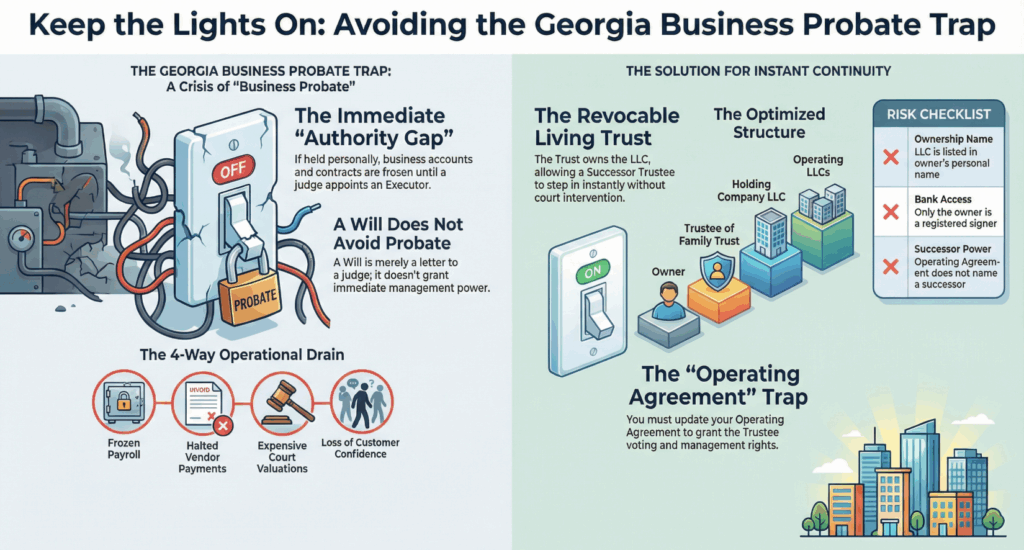
The most effective way to ensure business succession in Georgia is through a Revocable Living Trust. This structure removes the business from your personal name, meaning the probate court never has to get involved.
The Structure of a Protected Business
Instead of you personally owning the LLC, the Trust owns it.
- The Old Way (Risk of Probate):
- John Smith > Owns LLC
- The Optimized Way (Probate Free):
- John Smith > Trustee of the Smith Family Trust > Owns LLC
Because the Trust “never dies,” ownership remains constant. Your Successor Trustee (the person you choose) steps in immediately with full legal authority to keep the doors open.
Fast Checklist: Is Your Business at Risk?
You are likely at risk of probate if:
- Your LLC membership is listed in your personal name.
- Your business bank accounts only list you as a signer.
- Your Operating Agreement does not explicitly name a successor.
- You have partners but no updated Buy-Sell Agreement.
- Your plan is “my family will figure it out.”
The 3 Most Common “Bad Setups” That Destroy Businesses
Many business owners think they are protected when they are actually walking into a trap. Here are the three most common failure points we see in Georgia.
Bad Setup #1: “My spouse can just run it.”
This is the most common assumption, and it is usually wrong. Even if your spouse is smart and capable, they have zero legal authority if your ownership is in your personal name.
- The Result: The bank freezes the account. Your spouse cannot sign checks, and employees panic when payroll is missed.
Bad Setup #2: “I have a Will, so I’m covered.”
A Will does not avoid probate. A Will is simply a letter to the judge telling them what you want to happen after the court process is finished.
- The Result: Your business still enters the “authority gap.” The court process must start before anyone can legally manage the company.
Bad Setup #3: “I transferred my LLC to my Trust, so I’m done.”
This is the “sneaky” trap that catches even savvy owners. You may have assigned the LLC interest to your Trust, but you never updated the Operating Agreement.
- The Result: Your successor trustee has the right to receive income (distributions) but lacks the legal power to vote or manage. They own the asset but cannot steer the ship.
What a Safe Georgia Business Structure Looks Like
For most Georgia business owners, a secure estate plan involves four specific steps:
- Revocable Living Trust: Created to hold your business and personal assets.
- Assignment of Interest: Your LLC membership is legally transferred into the Trust.
- Updated Operating Agreement: The “rulebook” of your LLC is updated to grant your Trustee full voting and management power.
- Succession Plan: A clear Successor Trustee is named to take over operations instantly.
If you have multiple businesses, the structure often looks like this:
Trust > Holding Company LLC > Individual Operating LLCs
(This separates liability between your different companies while centralizing management.)
Don’t Let Your Business Freeze When You Do
Most business owners we meet are currently in “Bad Setup #1” or “Bad Setup #3.” They have a plan that looks good on paper but will fail in the bank lobby.
We can fix this.
We don’t just draft trusts; we structure business succession. We review your Operating Agreement, check your Buy-Sell provisions, and ensure your Trust has the actual legal authority to keep the lights on.